The first framework to attain Pledger Status of the Carbon Reduction code

SCF Construct are the first framework to attain Pledger Status of the Carbon Reduction code

SCF aims to lead the way to support our clients in ensuring their built environment minimises its carbon impact. Last year we launched our SCF Net Zero Carbon Guidance tool to help clients make informed decisions, we have rolled out a mandatory carbon assessment of all SCF jobs, and last week we are delighted to confirm our work has been checked, recorded and verified by the Cambridge Code, making SCF the first framework to attain Pledger Status, working towards Signatory under the Code.

The Framework is truly collaborative and has at its disposal number of major partners engaged in several working groups who focus on key themes to direct focus areas.  Specifically, it hosts the Carbon Emergency Response Group (CERG) who are a collection of national sustainability experts in the partners’ organisations.  The Carbon Code was a major focus of discussions in early 2021 and used to identify new opportunities to raise the bar to help ultimately reduce carbon on our projects.

Open the SCF Net Zero Carbon Guidance Tool
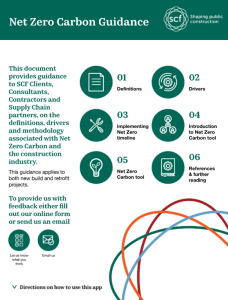
Open here:

SCF Operations Lead

I am really pleased that our work to support clients in minimising their carbon impact has now been recognised. Emma Bull, Senior Framework Manager, has been leading our Climate Emergency Response Group to ensure that our contractor and consultant partners continue to support clients in making Carbon central to the decision-making process in all SCF projects. We have a long way still to go, but I look forward to seeing our latest ideas and processes mature.

Cambridge Code

The University for Cambridge Department for Engineering has developed the Carbon Reduction Code for the Built Environment.  The aim of the Code is to align built environment organisations to support their and their partners’ journey to net zero.

The code comprises three areas of focus, namely core commitments for; all organisations, client organisations and finally supply chain organisations.  At SCF we work on behalf of client organisations and had already identified a need to assist and share knowledge with clients around options for reducing carbon.  From this came the development of our SCF Net Zero Carbon Tool guidance for clients, which also greatly assists in the Code’s focus on client commitments.

The codes guidance provides ‘core commitments for all organisations’ which was used to review partners’ net zero commitments.  All partners were able to illustrate commitment to some of the key principles, but a major omission the code identified was the ability to consistently measure carbon on all projects.

The group identified the need to collect meaningful data that could be used to benchmark future projects and use these benchmarks to target future improvements.  There were many good examples of projects achieving near to and net zero in operation, but there were inconsistencies in reporting criteria, scope emissions, in operation or embodied measures.

Baseline Reporting Tool

Our carbon baseline reporting tool was developed, a simple tool limited to measuring major building elements that carry the largest impacts.  These measurements are taken at major design gateways, namely at contractor engagement at the commencement of the second stage, prior to construction then post construction phases.  The information not only tracks progress and trends at those key stages, but also benchmark and therefore target improvements in projects going forwards.

Get Involved

Attaining Pledger status for the framework has helped to form the focus of our activities towards supporting a net zero future.  We would urge our clients, contractors and consultants to consider following us and using the code to support and formulise activities to raise awareness and ultimately help achieve a carbon net zero built environment.

The Code has been beneficial to not only SCF but other NACF partners.  We combined efforts with other NACF partners, namely SCAPE and NWCH who were invited to participate in the development of this tool.  Our next steps are to create a central database which, with support from other partners, will create a national database of carbon emissions set against key design / RIBA stages.

Similar to our market intelligence reports, the ambition is to share this knowledge nationally and help create a zero carbon built environment using tangible examples and real-time targets.